The Lotus Sutra teaches:
- All sentient beings possess the Buddha-nature. As long as they hear the Dharma and practice the Bodhisattva path, they will ultimately attain Buddhahood.
- The Buddha teaches sentient beings through the One Buddha Vehicle. The Three Vehicles of Buddhism exist only because sentient beings have different points of attachment. The Buddha uses various parables and expedient means to guide them, helping them break through attachments and emerge from their blind spots. Because sentient beings have various strong desires, the Buddha speaks of the attainments of the Arhat, the Pratyekabuddha, the Bodhisattva, and the Buddha. In truth, these are merely “toys” given to sentient beings so they may dwell peacefully in the “Buddha Way.” In the Lotus Sutra, these are illustrated by the parables of the goat cart, the deer cart, and the ox cart.
- Ultimately, the Buddha relies only on the “One Buddha Vehicle”—that is, opening up the inherent Buddha-nature of sentient beings, leading them to great enlightenment and the realization of the Buddha’s realm ofNirvana.
In the Mahayana canon, the Lotus Sutra is known as the “King of Sutras” and the “Foremost of all Scriptures.” This is because the “original face” of every sentient being is the Buddha; all beings possess the Buddha-nature. By hearing the Dharma, breaking through attachments, and uncovering their inherent Buddha-nature, they can attain Buddhahood (returning to the source of life and liberating themselves from various afflictions and the delusions of samsara). This insight is realized by the “Tathagata” alone in the entire universe. Beyond this, no other being knows it. Among the other religions we are familiar with, no leader has articulated this insight.
- If this insight had not appeared in the world, it would signify that the Buddha had not appeared.
- If this insight had not been formed into scripture, it would signify that the Buddha had not “revealed the Buddha’s insight.” Those who cultivate and realize the Buddha-Dharma but do not understand this insight are not true disciples of the Buddha. This is because the Buddha has not passed his treasure to you—a treasure owned only by the “Tathagata.”
- Without this insight, Bodhisattvas cannot liberate all sentient beings, cannot thoroughly break through all appearances, and cannot perfectly realize the fruit of Buddhahood.
- Possessing this insight allows practitioners to use the “mind of the fruit-level” to cultivate the “awakening of the causal-ground.” They recognize that every perception is a delusion, including the initial movement of ignorance in the universe, the Big Bang, and so on. Only then can the practitioner finally break through all appearances and remain detached while being amidst them.
- Knowing this insight allows us to realize that even when we are caught in discrimination and attachment, we are dreaming with the “Buddha-body.” All cultivation and realization are but matters within a dream; once one wakes from the dream, everything is already complete and present.
- To deny this insight is equivalent to severing the Buddha-seed and the wisdom-life of sentient beings. The gravity of such a sin is beyond words—it is more severe than shedding the Buddha’s blood or committing the five heinous crimes. This is the underlying meaning of the “Devadatta” chapter. Devadatta was a disciple of the Buddha and his cousin before entering the monkhood. After ordaining, he attained certain supernatural powers. Out of jealousy for the Buddha’s prestige and the respect he received, Devadatta repeatedly tried to harm the Buddha and split the Sangha, hoping to usurp the Buddha’s position and status. However, in the “Devadatta” chapter of the Lotus Sutra, the Buddha tells his disciples that even this notoriously wicked man will become a Buddha, and he bestows a prophecy upon him. This tells us that every sentient being will benefit from this insight.
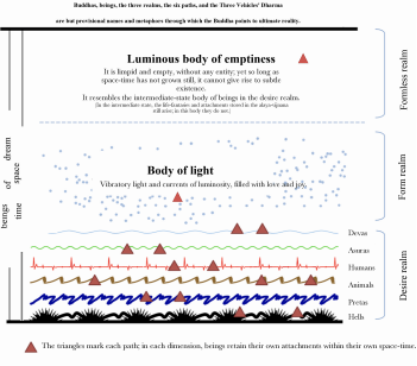
All sentient beings are originally Buddhas, existing within the Ocean of Nature’s Perfect Enlightenment.
Due to their various attachments, sentient beings manifest the differentiated appearances of the Three Realms and the Six Paths of Rebirth. To those who are attached, these realms are substantially real; however, to the Buddhas and Bodhisattvas who have liberated themselves from space and time, these realms are like dreams and illusions—like the foam and waves stirred up upon the Ocean of Nature.
From the beginningless past of kalpas beyond count to the never- ending reaches of the future, all life is trapped within “space-time” and cannot find liberation. Only the “Tathāgata” fully understands and realizes the illusory nature of space-time. Thus, the Tathagata knows all the dreams of sentient beings within space-time and all the attachments held within those dreams. Using various parables, expedient means, and skillful teachings, the Tathāgata guides sentient beings toward liberation from confusion and clinging. Because the points of attachment differ among beings, the Buddha teaches immeasurable Dharma doors and perspectives of immeasurable wisdom. The Buddha continually works to shatter the attachments held within the dream; his ultimate goal is not to enable you to live more comfortably within the dream, but to wake you from it so that you may ultimately attain Buddhahood. This is what the Buddha teaches in the Lotus Sutra: the sole mission of a Buddha appearing in the world is to reveal the Buddha’s knowledge and insight, to open the inherent Buddha-wisdom within all beings, and to lead them to attain Buddhood.
For example, when Sravaka disciples wished to leave suffering and attain bliss, the Buddha taught the Four Noble Truths. Yet these disciples did not realize that the suffering itself was a dream- suffering, inherently illusory. To hold a thought of “leaving” is itself an attachment that continues the dream. When Arhats grew weary of the cycle of birth and death and sought escape, the Buddha spoke of “quiescence as bliss.” However, “quiescence” is only defined in opposition to “birth and death.” If an Arhat does not realize that the “cycle of birth and death” is originally illusory, then the “mark of quiescence” remains within the dream. Therefore, the Nirvana of an Arhat is called “Nirvana with Remainder”; they have not yet fully awakened from the dream.
When Pratyekabuddhas contemplate the Twelve Links of Dependent Origination as taught by the Buddha, they believe that by severing one link, the wheel of birth and death will stop. This is still within the dream because they do not know that each of the twelve links is originally illusory. Since they are illusory, the intent to “sever” them is an attachment that continues the dream.
As for the Bodhisattvas, though they seek the Buddha Way and the Buddha teaches them the Six Perfections, if a Bodhisattva believes there is a “mark of a Buddha” to be attained or a “mark of sentient beings” to be saved, this is attachment. They remain in the dream and cannot wake up, for both “Buddha” and “sentient beings” are merely false appearances within the dream. The truth is: when the dream disappears, sentient beings are revealed as originally being Buddhas; there are no beings to be saved and no “Buddha-fruit” to be attained.
Therefore, the Buddha teaches in the Lotus Sutra that the Three Vehicles of Buddhist study are merely tools to shatter the attachments of beings within the dream. Sometimes, breaking one attachment results only in a small awakening; the being has not yet completely awakened from the dream to achieve Great Enlightenment. The purpose of the Buddha’s appearance in the world is simply to wake you up, not to accompany you in solving the endless problems that arise within the dream. Thus, the Buddha says in the Lotus Sutra: “I use only the One Buddha Vehicle to save all beings; there are no three vehicles.” There is only one True Reality in the Buddha Dharma: things are as they originally are.
Some may ask: “If we are originally Buddhas and the Ocean of Nature is perfectly enlightened, why do we dream and lose our way?” In truth, “Buddha” and “sentient beings” are merely convenient parables used in teaching. When a being’s attachments are completely shattered, the concept of “Buddha” also ceases to exist. “Buddha” is a provisional name established in relation to “sentient beings.” Because humans exist within the attachment of dualistic opposition, they must rely on the “mark of a Buddha” to shatter the “mark of a sentient being.”
When both the “mark of a Buddha” and the “mark of a sentient being” vanish, the Ocean of Nature is perfectly enlightened and all things are “just as they are.” This is what the Buddha describes in the Lotus Sutra as the “Ten Suchnesses.” In the “Ocean of Nature’s Perfect Enlightenment,” there is no “mark of wisdom” to be attained, for we originally have no “ignorance.” There is only “Suchness”: Suchness of appearance, Suchness of nature, Suchness of essence, Suchness of power, Suchness of activity, Suchness of cause, Suchness of condition, Suchness of effect, Suchness of retribution, and Suchness of ultimate consistency from beginning to end (Chapter 2, Expedient Means). “Suchness” means “it is just so.” This is the Buddha; this is the Buddha’s Perfect Enlightenment. The nature of every sentient being is inherently complete: self-nature is originally pure; self-nature is originally beyond birth and death; self-nature is originally self-sufficient; self-nature is originally immovable; self-nature can produce all phenomena. This is what it means to be a Buddha.